Podcast: Play in new window | Download
Subscribe: RSS





SEO is not a one-size-fits-all proposition. One of the most significant distinctions between a website’s ability to optimize quickly is its age. Old websites tend to optimize more rapidly than their newer counterparts.
Why? Because having been on the internet for years (decades in some cases), Google has indexed the website and noted its consistent presence. Therefore, even non-optimized websites with an indexed domain hold value for future plumbing SEO services.
In contrast, brand new plumbing websites take longer to optimize. Since there is no record of their existence on the internet (because it ceased to exist), Google won’t automatically trust it, even if it’s well optimized.
Web admins can’t accelerate tenure without producing an excessive amount of high-quality links, something that is almost impossible to accomplish for a local plumber and may cause penalization. Let’s discuss optimizing old vs. new websites:
Older sites are the easiest to optimize, and they can quickly achieve success through optimization. For example, if your plumbing company has been around since, let’s say, 1999, and has had a cheap website up since, let’s say, 2003, it has a digital tenure of 16 years.
Even if the site was pure trash from an SEO & content standpoint, the representation of your business on a legitimate domain name still holds value.
Once a professional SEO company optimizes your site correctly, you could see significant improvements in as little as 3-4 weeks. The only scenario in which old websites are non-favorable is when they’ve been manually penalized by Google.
However, your site probably does not have a penalty unless you intentionally built spammy links, violating Google’s guidelines.
Let’s go ahead and assume that’s not the case with your company. Here’s why age helps optimization:
Old domains possess inherent authority because Google indexed these addresses years and sometimes decades earlier. Thus, even if a website failed to live up to proper SEO, its existence within Google’s index is enough to establish a baseline of authority.
The age (tenure) of the exact web address influences its ability to optimize. You can check a domain’s tenure by using whois.com, which lists the initial registration date of the website. You can also view its visual history by visiting archive.org.
Google’s top priority is giving its users trusted search results. So it’s common sense why aged domains would be safer for Google to publish than brand new ones. After all, Google already evaluated every site in its index.
Many plumbers don’t have the luxury of optimizing an old website because they are a brand new business or never purchased a domain name. In either case, SEO is far more frustrating and takes longer to work. Still, newer plumbing companies shouldn’t let that discourage them from performing SEO.
There are methods to supplement traffic while you wait the 6+ months for your SEO to kick in properly.
You can target long-tail keywords and low-competition keyphrases to get your website indexed faster. Depending on your company’s location, you may have an easier time ranking for obscure keywords. For example, let’s say you service a city with a population of under 5,000 people.
You can probably rank for a phrase like sump pump repair in city, st sooner than six months in such a scenario. But, of course, more competitive keywords like plumber near me, will take at least six months, if not longer.
You can find a keyword’s difficulty using MOZ, SEMRush, or another similar SEO tool. However, since websites aren’t usually dedicated to sump pump repair, having high-quality internal pages that focus on that topic can rank websites (even very new ones) quickly.
So here are some things to focus on with a new website:
Sites with limited tenure should frequently publish new content to build authority on Google. Conversely, sites with little to no content have a more challenging time establishing trust and topical authority within Google’s index. Consider adding new service pages and blog posts each week.
Another way to speed up SEO for new websites is by associating your website with a reputable business. You can do so by enhancing your business reputation on online directories like Google My Business, Yelp, and plumbing-related directories.
Try driving traffic to your website from other sources besides organic search. For example, invest in Facebook Ads, share posts on social media, and start an email campaign with a tool like MailChimp or SendinBlue. Then, as more traffic comes through your website, Google may index pages faster.
Once a new website reaches a certain level of authority, it can compete with older and more previously established domains. The old website’s inherent advantage goes away once the new one sets itself on the same level.
The goal for new plumbing companies is to expedite the process as much as possible. Once you’ve established authority, whether, with a new or old website, you should focus on the following principles to sustain your search rankings.
As new keywords emerge, it’s your job to produce content that meets your consumer’s needs. For example, a page about cast iron drain repair helps signal specific service offerings to search engines and builds trust among present and future customers.
Likewise, showcasing a recent sump pump repair job is worth sharing on your service and city pages and may increase engagement for your website.
It is critical to keep up with Google’s latest algorithm changes and adjust your on-page SEO as necessary. For example, Google recently started using passage indexing which splits sections of your pages and posts into individualized results.
With this in mind, it’s a bright idea to break your content into different sections using headers and tables of contents. You should also build internal links for each new page you publish. For instance, your slab leak repair page should link to your common slab leak causes blog post.
Never stop promoting your brand and company on as many platforms as possible. For example, if a new social media platform emerges or a new plumbing directory, make sure you list your business information on the new website.
Not only can they serve as nofollow links, but they can help your company reach as many eyes as possible. In addition, make sure to continuously generate reviews for your business on as many review platforms as possible.
Podcast: Play in new window | Download
Subscribe: RSS
Schema markup is a boring & technical concept that could put most plumbers to sleep. But once they realize what it can do for their SEO and subsequent business success, they awaken rather quickly. Of course, the tricky part is getting plumbers to buy into the idea that a microdata tag language within HTML coding can directly impact their bottom line.
But bear with us because we’ve tested schema for plumbers extensively over our decade-long management of plumbing contractors’ digital presences and have experienced nothing but an enhancement, success, and competitive advantage. But the technical vocabulary can be tedious, even for web designers.
Schema is an extra layer of code inserted into web page HTML, labeling pieces of data according to relevance. Schema tells Google what things are. For example:
If you use Google’s Chrome browser to surf the web, you can click CTRL+U to bring up the source code. It might look like gibberish to you, mainly if you’ve never studied programming or back-end website design, but it is something that Google’s web crawlers intimately understand. Furthermore, it is how websites communicate with Google, which, as you might imagine, can heavily influence the perceived value of a website and its ultimate position on Google rankings.
So don’t mistake a lack of understanding for lack of importance. Google perceives that code, and that’s what matters. At the same time, most people focus on the front-end of a website (the visual component), but it is far less relevant to organic SEO than the source code. So think of Google crawlers when performing any technical SEO task, which ultimately contributes to higher rankings.
It’s natural for the average internet user to focus on the presentation of a website and not its back-end source code. But what if they never see the front-end presentation? Because that’s what happens to thousands and thousands of sites every year. They are buried on search rankings and fail ever to exhibit their good presentation to the masses.
An appealing website can help with conversion rates, closing the deal, and keeping visitors on the site longer (decreasing bounce rate), but it can’t get them there initially. Unfortunately, it’s not uncommon for aesthetically pleasing websites to have a putrid code base that directly impacts business sales. All because of a pathetically atrocious code base behind a nice-looking visual.
Before schema code was an absolute powerhouse in web design communities, semantic markup was the original version. It still holds value to this day, albeit on a less specific scale. Semantic markup helped Google parcel web elements on a page. For example, it would tell Google this is the header, the body text, the sidebar, the footer, etc.
Of course, this is important for Google to understand, but schema takes it to a whole other level. For instance, schema can say that a business address, company logo, etc. The two methods don’t conflict with one another, but instead, the schema is the natural progression of semantic markups’ original intention. Plumbers should take full advantage of this evolution when designing their company website. In addition, it can have a direct influence on Google’s rank positions.
In our experience, 99% of plumbing websites use template websites before investing in our services. Unfortunately, the lack of success from these websites drives them to pursue a new marketing campaign. But sometimes, these template websites do have schema code. So why does it fail? Because having schema can range from 1-2 schema code blocks to hundreds of thousands.
So while your template website might have fundamental schema code, it does not have the advanced code that Google values. It might tell search engines basic business information, but to compete for the top rankings, you’ll need much more detailed information than that. One great example of advanced schema is aggregate star review ratings which show the 5-star rating of your business. Plumbing Webmasters tracks about 100 types of schema code on a standard client.
The more Google understands about a website, the more effectively it can market it to consumers. Furthermore, the more revealing a website is about its contents, the more Google can trust that it’s worthy of being ranked on SERPs. Another factor regarding schema & SEO for plumbers is the SERP presentation. We mentioned the appeal of the aggregate star review rating.
When this becomes an extension of your website result on Google SERPs, the click-through rate increases exponentially. Schema helps your site earn trust from Google and effectively markets your services to relevant consumers. In addition, it encourages superior user behavior metrics, which, as we know, are very important for ranking positions. To sum up, schema’s relation to SEO, consider these:
Schema markup aims to help Google parcel data and effectively promote your website to relevant users. Because of its heavy influence over SEO, it deserves significant attention and resource allocation. We cannot stress enough the importance of this factor for plumbing SEO. With professional designers on staff, we can help you take your web coding to the next level in 2021.
Podcast: Play in new window | Download
Subscribe: RSS
2019 promises to be a big year for plumbers. Check out our SEO for Plumber’s guide if you have not done so already. Today, we will discuss an actionable checklist that every plumbing contractor can utilize to gauge the progress of their web presence and identify points on which improvement is necessary.
As a digital marketing agency working with plumbers for almost a decade, we have the resources at our disposal to put companies in a position to succeed in the online space. The goal for all plumbers is to make more money. The best way to do that is through online lead generation, the majority of which happens via digital marketing campaigns. In this 10 point checklist, we’ll touch on the most critical aspects of SEO:
The front end of a website is what most consumers think about once they enter. It’s what most contractors think about when evaluating their plumbing websites. But the reality is that the front end is predicated entirely on a structurally sound back end. What good is a visually appealing website that nobody visits? What is its value to plumbers? The truth is that visuals only matter if you get the visitor to enter in the first place. That’s not possible without excellent website design.
So what makes web design suitable? For starters, a professional designer should create the framework. They should implement a clean and SEO-friendly code base, as well as SERP enhancers like schema markup. Does that all sound a little bit foreign to you? It should be because programming is not something that the general public understands. The need for professional web design is pressing, and it’s even more beneficial when the designer has a background in search engine optimization.
A solid codebase can place sites in an initial position to generate traffic. But the visual appeal, user experience, and navigability are what will keep them there. Google measures website performance in large part by how the user behaves after finding the site. If they exit immediately, the site’s bounce rate goes up. The higher the bounce rate, the worse your website is performing. One additional factor regarding design is how easy the website makes it for users to locate pertinent information. That means where to find you, how to contact you, how to review you, etc. These blocks of information should all be displayed prominently on a website. Plumbers should ensure their website excels in these areas:
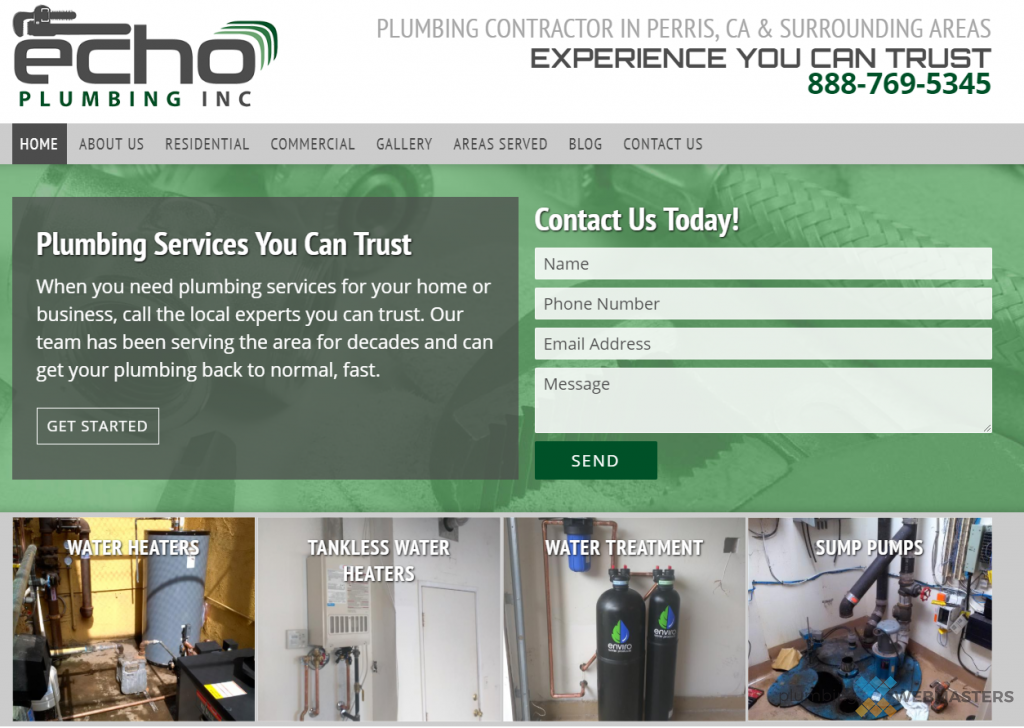
Many points on the SEO checklist will tie directly back to design, which is why it is #1 on the list. The codebase is a prime example of an extension of design but requires its undivided attention. The back end of a website is made possible by coding. Whether it’s HTML, CSS, JavaScript, or any other kind of programming language, it matters for your website. What makes code so critical to website success is the language through which Google interprets the virtual object. What’s your company’s name, where is it located, what are the services, etc.
The front end of a website can promote these pieces of information through content, while the back end must use a microdata language known as schema.org. Most people reading this post use a template website for their plumbing services. Unfortunately, while it may have schema code, it isn’t likely to be optimal. Worse templates guarantee duplication of a codebase with other sites on the internet, sometimes even your competitors. But those listed above you for primary keywords more than likely have a custom code base rather than a premade template.
You can mark up almost every single component of your website with schema. Schema helps Google parcel your site’s data and understand its content to promote it best. The microdata tags can also encourage SERP enhancements which add exciting features to your search results, such as aggregate star ratings and site links. Much like ad extensions for PPC, SERP enhancements can make an organic impact outrank one that’s competing with it. A proper code base should exhibit these qualities:

There’s probably no word used more in the world of digital marketing than content. People swear by its value, and as Google’s algorithm has evolved, so has the standard for creating SEO-friendly content. Yet, to this day, many websites still exhibit shallow content. Content stuffed with keywords over and over again reads unnaturally and looks as if a 3rd grader wrote it with a poor grasp of sentence structure. The content that should be on your plumbing website is natural. Write your pages as you would want them described to your target customer. Consider identifying LSI keywords, natural synonyms, and terms related to your primary word, and place them within your content.
The presence of LSI keywords helps Google interpret a web page as robust and uses natural language that relates itself to the subject matter at large. The process of SEO writing has had difficulties shaking the tradition of keyword stuffing because old habits die hard. While using the keyword within the title tag and header tag is still encouraged, it should not be used more than once or twice within the body paragraphs themselves. A good rule of thumb is not to publish any content that doesn’t reflect how you would describe a service to customers in person. The written content is different from its spoken counterpart, but its entire presentation should mirror your direct intentions. Content on plumbing websites should favorably exhibit the following qualities:
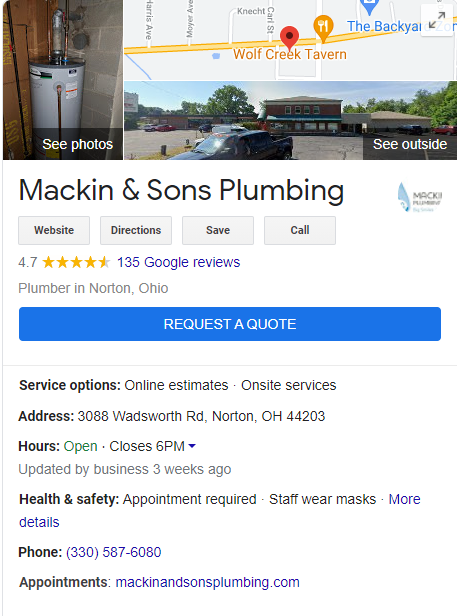
Google My Business is the easiest thing to get right for plumbers who are marketing their services online, and it happens to coincide directly with your company’s Google Maps listing. But there’s a caveat; it’s also one of the easiest things to screw up. Messed-up listings are usually a result of plumbers trying to do too much with their GMB account. It’s a fundamental concept. GMB tells Google the name, address, and category of your business so that they can adequately promote you to consumers in your local area on Google Maps. So that’s the very base level of Google My Business, but there are also additional steps that can make a GMB listing even more impactful.
One of those is the FAQ section, where the business owner answers frequently asked questions from consumers. Plumbers can also put in branded company photos, like pictures of your office, truck, etc. Don’t forget your company logo. Most plumbers understand that local SEO is essential, and Google Maps is the foundation of every local SEO strategy. Optimizing your Google My Business page encourages Maps placement. Here’s what you should attend to regarding your Google My Business:
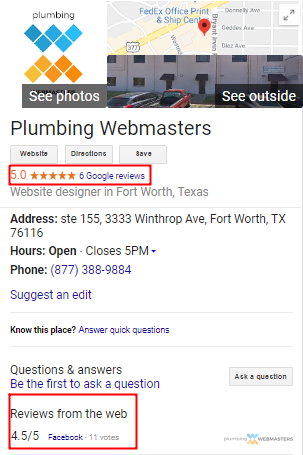
As we noted earlier, points on this checklist tend to relate to one another. Google My Business is one of the best sources of customer reviews, which brings us to the following checklist point for plumbers, which is online reviews. While Google should be a top source for reviews, it should not be the only source. For example, if you get ten reviews, about 5 of them should be on Google. The others can disperse to Facebook, Yelp, BBB, and several other worthy platforms. Google has even publicly discouraged the notion that all reviews should affiliate with Google My Business.
But to diversify reviews, you have to generate them and do it ethically. It would help if you actively pursued reviews by asking satisfied customers in person and integrating a reviews dashboard that automatically texts clients your review profiles on Google and Facebook. In addition, it would make it convenient for anyone on your website to click the review us button. Be careful about who you do ask for feedback, however.
If you had significant problems with one of your clients, and you know that they were challenging to work with, don’t promote your Google or Facebook account to them. Hopefully, clients like these are few and far between but don’t go looking for bad reviews. Although they will be inevitable at times, you can drown plenty of good ones, as well as your direct response to the bad ones with professional reactions. Make sure you monitor these aspects of your reviews:
A website builds authority by the number of inbound links that point to it. MOZ measures their collective influence with a metric called domain authority. While DA is not a Google metric, it provides a general snapshot of the strength of inbound links pointing to a particular website. Domain authority (DA) measures on a 1-100 scale, with 100 being the most authoritative link profile imaginable and 1 being a link profile that ceases to exist. The whole concept of link building is dangerous for SEO. Not all links hold equal value, and many times, links can distract plumbers and other website owners from more manageable SEO tasks.
In 2012, Google’s Penguin update ended manipulative link building and heavily penalized sites that broke guidelines. Fast forward to 2019, and while penalties are no longer as typical, the value of low-quality links is pretty much zero, if not hostile. So how do you build links? The only avenues are creating great content, building citations, sharing on social media, and conducting PR and blogger outreach. The most valuable links come organically. If you write a great blog post about plumbing, share it on social media, and another blog links to the article, you’ve earned a precious organic link. This process is hard to execute; make no mistake. But consistency and attention to detail help make it more probable. Keep an eye on these link-building metrics.
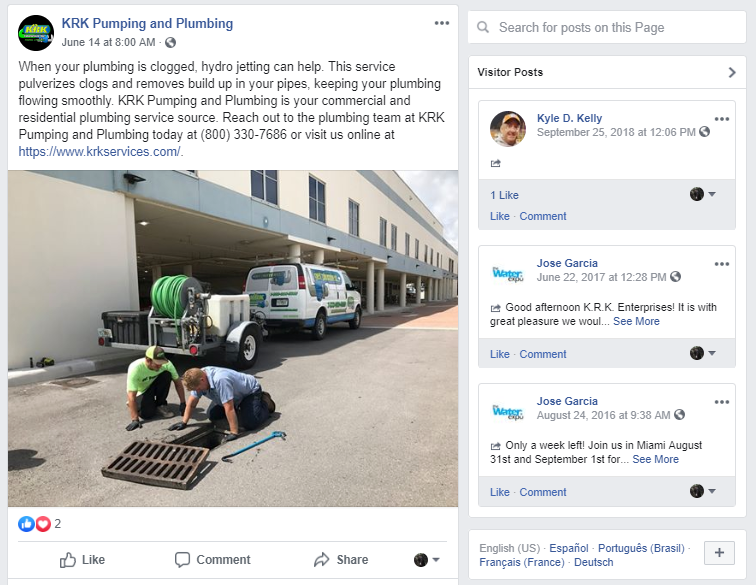
Social media and SEO are related, whether you want to believe it or not. Many plumbers don’t want to hear that because they hate social media. And we don’t blame them. After all, how does an anti-social plumber utilize social media in 2019? Truthfully, you don’t have to be a digital celebrity to make an impact on Facebook, Twitter, Instagram, Linkedin, or YouTube. All you need is a legitimate presence on each platform. Unfortunately, Google has not been forthcoming about the direct influence of social media activity on search rankings. Still, evidence suggests that social signals take into account in one way or another.
That’s why publishing blogs on Facebook, Twitter, and LinkedIn produce visual content for Instagram and YouTube. When people are engaging with your business, whether it likes, shares, views, comments, or otherwise, it signals to Google that your company is relevant and noteworthy. Again, you don’t have to be a typical social media personality to send out these signals. After all, you’re looking for engagement from plumbing customers. People who are your clients, or who will one day become them. One thing to consider with Facebook and Instagram is that you won’t get many organic impressions. If you want to be seen organically on these platforms, you’re going to have to pay to advertise on them. But branded searches still matter. So when consumers who have pre-existing knowledge of your company look for you on IG or Facebook and don’t find you, that’s a missed signal opportunity that could go to Google. Keep these things in mind when auditing your social media presence:
Is your plumbing website stagnant? Also, do you add new blog posts each month? Finally, Have you invested in a website redesign? In any case, you are jeopardizing your position on Google SERPs or preventing yourself from improving. SEO is not a one-time deal. To truly master SEO, plumbers must commit to consistent optimization tasks. Google constantly changes its algorithms as they evolve, and activity will also be necessary. That’s no different than any other form of marketing, whether it’s online or not. If you don’t make incremental improvements each month, year, and decade, you can’t expect to thrive in your marketplace.
An example of Google’s evolution relates to content advancements. Google used to reward content written a certain way and ranked pages with keyword stuffing. Today, those same techniques will hurt your rankings. So if you never updated your content, you lost major spots on Google’s SERPs. Ongoing work is imperative to sustain a certain level of ranking and improve upon it. And it goes beyond content. Other areas that require continuous attention are coding, design, and user experience. Plumbers will want to take special notice of the following areas when checking for ongoing work:
Plumbers tend to favor paid advertising, especially PPC from Google Ads, because it works quickly. PPC can be a significant part of an internet marketing strategy, as long as it coincides with macro-scale efforts like SEO, web design, etc. The problem with PPC is that it’s inherently short-lived. You can’t expect to make a living off of PPC ads. There are pockets of time when you can create significant ROI, but it cannot be your only source of traffic or lead generation if you expect to sustain success.
Furthermore, PPC only works with properly managed campaigns. Budgeting, targeting, and landing page optimization are crucial elements to Google Ads, and ignorance of them will result in a failed venture. Google is not the only paid advertising platform available to plumbers. Contractors can also invest in paid social media advertising like boosted Facebook posts or even Instagram posts. As we noted earlier, Facebook doesn’t show posts organically, so paying for promoted posts is one of the best ways to activate the social signals that influence SEO. Again, paid ads can be beneficial but only maximize when they are part of a more effective digital marketing strategy and one founded in SEO and website design. Ensure your paid advertising campaigns have these things managed:
New forms of media have inserted themselves into the SEO discussion. Whether it’s video content, which has been around for some time but has recently started to become easier than ever to produce, or podcasts, which are an undervalued media format for any business, their collective influence over brand authority can be significant. The more signals a brand can send Google that is relevant and noteworthy, the more authority it can establish online. Podcasts and videos are great because they can be distributed and syndicated on multiple platforms. With podcasts, those can be Apple, Spotify, Stitcher, and embedment on your website. With video, it can be YouTube, Instagram, Facebook, and also embedment on your website.
Multimedia provides seemingly limitless options for plumbers, but convincing them to participate in producing this content can be challenging. If you are a plumber looking to take your business to the next level in 2019, you should more than consider a multimedia campaign; you should invest the resources required to do it. Brand authority is measured in more traditional ways as well. In other words, website design, logo design, and content marketing are also indicators of brand authority. But for this checklist, focus on these newer concepts:
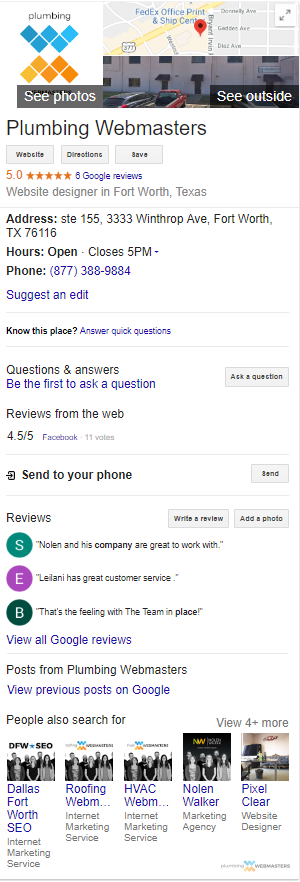
The Google homepage is an industry term for a phenomenon that exists with branded searches. When a consumer with pre-existing knowledge of your plumbing company types its name into Google, the entire SERP shows up for branded features, including the Knowledge Graph. The Knowledge Graph appears on the top of SERPs and shows your GMB profile and NAP information. It should also include a page full of organic results associated with your company, which might consist of everything from your website, social media profiles, and other business directories across the web. The bottom line is this; you want your branded SERP to look great. It will only look great if you’ve attended to each primary point of this checklist. So what are the components of an optimal Google homepage?
Podcast: Play in new window | Download
Subscribe: RSS
Each year SEO evolves, and those who keep pace reap the rewards. If you haven’t reviewed our SEO for Plumbers Guide, you should do so promptly, but if you’ve already read it, you might want to learn more about specific mistakes to avoid this coming year. The mistakes to avoid this year will be mostly the same as the ones from last year. However, for others who have not studied the digital marketing landscape in quite some time, the tips suggested through this podcast and blog post will be eye-opening. Here are the top SEO mistakes plumbers should avoid in 2019
Template websites are one of the most common SEO mistakes, and therefore essential to address. Contractors continue to choose them over custom designs because of their low cost. These template websites are cheaper because they require no professional design experience. The downside is cookie-cutter coding which hinders SEO efforts. While some template websites continue to look more visually appealing, their back-end coding causes SEO problems.
When you look at the most amazing plumbing websites, they visually appeal to users and rank well on Google SERPs—having one without the other defeats the purpose of digital marketing. Of course, you want users to have a great experience on your website, but they have to find it online first. Finding a balance between design and ranking is critical to SEO success, and template websites discourage plumbers from reaching their goals.
PPC is popular amongst plumbers because it’s the fastest and most surefire way to rank at the very top of Google. The prevailing wisdom for contractors is that everyone clicks on the ads. But ask yourself, do you click on the ads? Do I click on the ads? In both cases, the answer is no. So why is the assumption that everyone clicks on PPC results? At a recent SEO conference in Dallas, TX, experts stated that 76% of all clicks come from organic results.
Keep in mind that Google Maps rankings are organic, so most local searches also come through SEO. The idea that everyone clicks on Google Ads conflict with statistics, suggesting that only 24% of searchers click ads over organic results. Other studies claim ads generate a higher percentage of clicks, but SEO is generally more favorable. Still, as a company that has provided both services (Paid & Organic) for plumbers, we can attest that organic results produce a higher ROI.

Good SEO agencies follow Google’s guidelines and abide by their standards. So why then do plumbers hire a single in-house marketer who claims to be smarter than people who have their own marketing company? Relying solely on an in-house marketer is one of the biggest SEO mistakes for 2019. We’ve had plumbing companies contact us via their in-house marketer, who then tries to tell us what works best for SEO.
Our response is simple; why are you calling if you have all the answers? We respect the jobs of marketers; after all, it’s our industry. But we have a team of uniquely skilled employees that can help you with every aspect of your campaign. Unfortunately, plumbing companies with in-house marketers often still lack the results they covet online. One-person marketing teams don’t have the resources to produce content at scale, validate NAP citations, and manage reputation.
There are many components to SEO, but doing any one of them on its own is not enough. What makes SEO effective is collaboration and cohesion. The more signals you can send Google, the better chance you have to rank as a plumber in your local market. For instance, writing content only is not enough. Having a website only is not enough. Getting plumbing leads only is not enough. Here’s one; PPC only is not enough. Are you starting to get the idea? If you find that competitors outrank you for the top keywords, it’s because they are doing things that you neglect.
The lack of understanding is often not plumbing companies’ fault because so much misinformation exists online. But doing the proper research and preparation can help you avoid the pitfalls of some of the lower-end marketing companies looking to manipulate home service companies. Standalone services like those offered by self-proclaimed Facebook Ads gurus can spell the demise of your business. Investing in a full-service digital marketing agency is the only logical way to grow your plumbing company.
Podcast: Play in new window | Download
Subscribe: RSS
As a marketing agency that handles plumbers, we’ve seen contractors get taken advantage of before joining our service plan. Many come to us after being frustrated with their previous online marketing experience. In the majority of these cases, plumbers are unhappy with their last agency’s pricing model and feel that it favored the marketer over the client. The sad part is they are correct.
We see it all the time. Marketing agencies will manipulate their prospective clients with propaganda and end up costing them massive amounts of funds. Manipulative pricing can dishearten plumbing contractors. As a plumber or other small business owner, we, as marketers, cannot expect you to understand the nuance of every promotional technique. But this lack of understanding is, unfortunately, how agencies trick their clients.
Marketers know more about specific techniques and frame them to mislead customers. Their tactics fall nothing short of modern-day snake oil. Arming yourself with accurate information like SEO tips for Plumbers is the best way to avoid businesses like these. Here are some of the primary digital marketing pricing packages exposed:
Black Box PPC asks for an immediate upfront payment from the client. The marketing firm is then supposed to spend the money in any manner they see fit — most often on PPC advertising (Google Ads). But guess how much of the payment that many of these “experts” pocket? In many cases, it’s 50%. That’s right, half of all Google Ads money goes directly in their pocket. So what’s the problem? That money is supposed to go towards Google Ads, and therefore you should be billed by Google, not by some self-proclaimed PPC expert sitting in another state or even in some cases, another country.
Since Google publishes the ads, it’s natural that reports should come from Google. But these marketers don’t send Google reports to their clients. Instead, they send their notifications so that they can mislead the client and exclude essential information. In worst cases, they mark your company name as a paid keyword to claim success for branded searches which you are getting from SEO, anyway. Here’s a summary of their tactics:
If your conversation with a marketing agency starts with them asking how much you can afford to spend, you know you’re dealing with the digital equivalent of a used car salesman. The question should not be how much you can afford to pay, but rather, what the best deal is for you and your marketing endeavors moving forward. This opening question is frequently associated with a pricing concept known as the shell trick. They tell you some money is going towards SEO, some towards PPC, some towards social media, and so forth. The list of categories is usually lengthy, so it seems like they spend your money on various techniques.
When you look at it from a visual perspective, it seems logical. It seems wise to invest resources in all these different areas. That’s why it’s a great marketing pitch. But what you should focus on is the bottom line price. Honest marketers will provide all-inclusive services for a fixed price, so there are no add-ons or extras, which should be pre-included in the package. The worst part of companies that utilize the shell trick is that most of the time, the majority of services they promote are usually left unattended during your service tenure. They instead have slick salesmen send you reports that mislead you as a client.
The one-trick pony package is the opposite of the shell trick, but the sales pitch is similar. The “pitch” of this concept is that one particular marketing technique is all you need as a plumbing company. It can be anything from reviews generation, maps optimization, citation management, etc. These services typically cost in the range of $199 to $299, and those numbers can often be appealing to newer contractors working in smaller markets.
Plumbers feel they are saving money on marketing services by cutting out unnecessary services. That’s why it seems to contradict the shell trick, but the result ends up being the same. In a case like this, the problem is that one service will never be enough to compete against top-ranking plumbers. In digital marketing, all concepts work together, so the one-trick pony services are bad for business. Most times, the one service they offer is a glorified hosting fee. You’re paying them to put your website up and report on its NAP citations.
Email blasts claiming your website requires an SEO upgrade is one of the oldest industry sales tactics. The marketing firm emails every address they can find without analyzing the website. Such a tactic is known as mass email blasting, and it’s nefarious at best. The pricing proposals presented in most of these emails are misleading and inaccurate.
The same is true for telemarketers. They are fishing for clients by going down a list of phone numbers they acquired, whether online or through data mining. You should avoid going with email or telemarketers at all costs because they can’t get clients through SEO, the service they claim to be selling. The best way to find SEO services is by using the method homeowners use to find plumbers. That’s through organic search; Google Maps listings, reviews, etc.

Hey, there is Nolen Walker for Plumbing Webmasters. I’m going to enjoy this one. Online marketing prices exposed. Online marketing price is exposed. I get so sick of talking to people and hearing all this stuff … not talking to you guys, but hearing how you get screwed around over and over again. It’s one of the reasons we have a month to month pricing here. People get set up, they’re not tied in. We produce stuff.
So let’s talk about all the things that people do and they get they get so over sold on this stuff, and this is all real. There’s so much propaganda. It’s hard to tell who’s who and who’s a quality web company. So let’s dive right into this stuff because these are things i hear on a daily basis. Just saved somebody from this yesterday ….yesterday, came on board … and had what I call black box ppc billing. But what’s that Nolen? That’s when someone’s naive and they don’t know. And that’s ok, by the way, it is okay not to understand this stuff, but you sit here and you listen to videos like this and podcasts, and we explain it to you.
Okay, so black boxing the pay per click, is when you just hand them the money is when you just hand them the money and then they’re supposed to spend it. Now, i will tell you and i will not mention this company’s name. It’s a national company, name brand. We hired a guy to do some AdWords management for us and we got rid of him because he was just kind of and we got rid of him because he was just kind of not a nice guy. I’ll leave it at that, but what the company did was a black box everything. Guess how much of the paper click they took was they black boxed everything. Guess how much of the Pay Per Click they took?
People don’t ask. They go; Hey, i’ll spend three grand a month, i’ll spend five thousand a month, i’ll spend fifteen hundred. Whatever. It doesn’t matter. Whatever they can get you to do. Doesn’t have any rhyme or reasoning. Anything that gets you spend as much as possible They take fifty percent. Fifty percent of the money was spent on that. I will tell you that i believe that sometimes one hundred percent is done. I hear people going with the guys that do AdWords management. They’re like, oh, he lives in, you know, Thailand. He’s here or there. Yeah, I bet he does.
Your black box billing and he’s supposed to be getting leads or whatever he’s doing, all he’s doing is managing your AdWords. And I don’t have a problem with managing AdWords campaigns. But we’re transparent so we charge the fee to us and then your credit or debit card gets billed directly from Google. So is transparent. It’s not a black box scenario.
These people, from national companies to the kid living in Thailand doing your stuff, they’re sending their own third party reporting. There’s reporting from your Google account, but they don’t send that to you. They also do stuff like putting your company name for a Pay Per Click term and then claiming success over that for the amount of clicks you get or it drives the cost of the apparent click down. So it looks better to you. There’s a lot of stuff that goes on in the world of Adwords Management that’s bogus as all get out. You can have this done well, but you want to know where your money is being spent.
This is really good stuff. So if you think you know some of this stuff, stick around, i’ll explain it all to you, So we don’t do any of this stuff by the way. The Shell Trick, this is one of the most common ones done. This is done by hard sale, big tactic, companies, some of the most aggressive boutique private equity companies do exactly what I call the shell trick.
They’ll take your money and they’ll say Nolen … and it’s kind of like going on a car lot and saying, how much can you afford on your payments? Sir, if you spit out a number than their profit just went through the roof, right? Not how much I can afford. It’s the best deal, right? And so same thing on the shell trick. So they go. Oh, let’s get five thousand from you. Let’s get three thousand from you. Whatever it is. Let’s get two thousand from you. I call it the shell trick because they’re like, oh, we’re going to put a little money here on the SEO, we’re gonna put a little money here on the mapping, we’re gonna put a little on the management, the PPC, the hosting, the reviews, and it looks like all this good stuff.
All that stuff is normal crud we do anyway. Citations and design, blogging and content, regular work and postings, and domain authority. And all this stuff gets done anyway, it’s part of it. The mapping, of course, is part of it. Integrated reviews… But when they start splitting it up, it looks logical to you. Like what? I need a minute. Okay, they’re doing three hundred dollars on mapping. They’re going to do SEO for a thousand dollars. And then the management figure, there’s a management fee for four hundred, there’s some hosting and some reviews, and then what’s left for PPC guys and i’ll tell you something. Do you know what they do? I call it glorified hosting.
A couple of things, they typically don’t touch the stuff that’s supposed to be done. So let’s say So let’s say that you decided to spend with this company. I’ve got one specifically in my head, but i’m not gonna sit here and talk about it. But there’s many that do this. Some of them do it really hard core, and then you scream, reeling, from the bloodbath that you’ve had financially after you’ve done it for a little while, but oops, you’re stuck in an agreement. They talked to you in twelve months or six months or whatever. So when you get out, you run kicking and screaming.
Very little of that goes to the Pay Per Click that you had. You might end up spending three grand and had a thousand dollars go to that, unbeknownst to you, and then the phone doesn’t ring enough. The rate of return is bad. And then the stuff that they’re supposed to do on map and SEO and reviews and management… they did almost nothing except put up reports for you and have slick people talk to you on the phone to keep you on the hook. That is a very common thing and I called it the shell trick.
The one trick pony. One thing is going to save you. We’re going to do mapping or we’re gonna do, oh gosh, reviews, mapping, citations. These are things that are common… people buy into them. It’s really the $299 scam. $199 to $299… and I really just made up a name, frankly, for right now, but I know that people love paying $299 per month. We don’t do $299 because we can’t afford to have quality services for $299. But for whatever reason, everybody out there loves paying these low amounts. It’s illogical. You can’t do hardly any work for $299. You certainly can’t get a group of web people have you dominant in a primary market for this amount of money.
I call it a glorified hosting fee and i have called it that for years. You’re paying $199, $299, you are paying a glorified hosting fee. Because why? They don’t do any work at all. So this is some sort of automated thing. They’ve got you hooked up to some citation service with a little report that kicks out to you and they do the big goose egg. That’s how much work they do. And then you get no organic optimization. You get nothing out of that deal.
So if you bite on to $ 299’s over and over and over again, five hundred bucks and below, you’re going to get glorified hosting fees, and it doesn’t work because they didn’t have enough resources to do anything. But everybody seems like paying that price range. So be careful on that. One trick pony fits in that.
One thing doesn’t make marketing work online. Google checks all sorts of things. There’s all sorts of triggers and clues and grades and points that you get from lots of things being done all around the web. Design and content coding and graves and points that you get it from lots of things being done all around the web. Design and content and coding, citations and linking, domain authority, blogging and regular account changes, content additions, content changes, Google Maps postings, videos, and all this stuff is done, and it can work really well and it sounds like more than it is. It’s hard to do for a company, but it’s what we do for a living.
So emails, telemarketing kits and hacks on Facebook. The emails that come in, guys, they’re all bad. No, your website isn’t necessarily broken. I get them, everybody gets them. We get him and our websites or fantastic and kick butt but we get the same videos that everybody else does. So the more popular you get online, the more emails you get out of foreign countries and everywhere else.
They’re just fishing…, fishing for you to buy and you get on, and then you’re off to some horrible company. Please avoid those places. The telemarketers are the same. The only thing in common with the telemarketing companies and emails is that they’re good at market outreach to get you.
But you should find your web company through organic optimization, probably right? Methods people would find you on. Reviews, organic optimization, social media, the same best return places you want to get found. Buyer beware if you fall for the emails and telemarketers, the kids and the hacks on Facebook. They’re sitting at home, they’re sitting at home listening to programs on how to do stuff. No resources and very little skill sets and running stuff like Pay Per Click, but making it sound like it’s a lead generation system that they’ve created, that some fancy funnel click words like funnels, landing pages, industry jargon meant to kind of propaganda and overwhelm, and make someone feel like they’re missing out on something.
Funnels is a fancy way of saying proper marketing. Look it up. Look at a picture of it on Google. It’s getting people to find you and then give them some information and then work them with the emails and stuff and talk to them and they become a lead, it’s a funnel, but it sounds like something fancy that you’re missing. It’s not. It’s just proper marking.
So these are all the different things that go on the industry’s when we get someone in here that we work with, we’re very straightforward, transparent, all this shell trick stuff that people try to throw into one mega package and then suck off tons of money on it, we’re way way less expensive. And it’s just part of the whole thing that we do, because if you don’t do all this stuff, it doesn’t work.
The one trick pony doesn’t work. The shell trick stuff. I call it that because they try to divide it all up to make it look like they’re doing more and you end up spending more money and paying for fancy stuff. You know? Account representatives, keep you in line. We have account reps too, but it’s not done from a sales jargon, BS, sort of way.
We’re very respectful to clients and the efforts, the resources are put in to get the client return. So kind of, yeah, this is what I run into on a regular basis. If you’ve heard any of this before or any of it sounds familiar. It’s rampant in this industry for some reason. We’re a great company to work with. We’d love to hear from you someday. We’d love to be your web company. So got any questions, call us and we’ll give you a free site evaluation concerning these questions and tell you how much we charge. We would love to hear from you. Thank you.
Podcast: Play in new window | Download
Subscribe: RSS
Most local service companies, including plumbers, utilize city pages as part of their local SEO strategy. Unfortunately, in the past year, Google has made it more difficult to optimize these pages. Traditionally, city pages with thin, short, and similar content still ranked well on SERPs.
For example, if you were a plumber in Dallas, location pages for hundreds (or even thousands) of other cities, counties, and towns in or around the DFW area would rank for relevant keyword terms.
Google finally said enough is enough and altered its algorithm to prioritize unique and customized location pages.
After all, too many city pages were serving as nothing more than doorway pages to the plumbing company’s homepage, where they could convert a broader region of consumers into new customers.
As a result, entire sites suffered because their site promoted duplicate and spammy content (let’s be honest, that’s what city pages have been). So city pages in their traditional format now hurt SEO. Plumbers must adjust to ensure they can still rank in multiple service areas.
Plumbers in major cities might target a single location because their population is large enough to produce significant lead generation. But most plumbers still want even more business, in which case they should create unique and customized city pages for each additional location.
Plumbers should avoid publishing more than 15 city pages to preserve a healthy crawl budget and steer clear of polluting Google’s index.
Plumbing companies should customize each page with logical and informative writing that speaks directly to local residents. For plumbers whose main city is a small town, additional city pages become critical for producing enough online leads to compete.
But, again, make sure they are both custom and unique. While you might do more cities than someone in a major metropolitan area, you still don’t want too many.
Duplicate content is trash and creates a porous user experience. The user knows when they are reading poorly written or mass-produced content. The question is, do they care? The answer, as Google sees it, is yes.
Although plumbing consumers aren’t looking to read long paragraphs about a service, they are looking for trust indicators from its website. With this in mind, duplicate content makes a website look like spam and discourages potential customers from completing a call-to-action.
Consider these factors when analyzing duplicate content:
People confuse plagiarism with duplicate content. Stealing content from another website and publishing it as your own is plagiarism. Conversely, mass-producing identical pages on your website is duplicate content.
The reality is that most duplicate content does not cause a manual penalty. Additionally, the type of duplicate content that relates to city pages is not coming from external domains. It is duplicate content on the same site.
Google’s negative impact on dupe content is algorithmic rather than manual. In other words, the algorithm knocks down traditional city pages programmatically based on machine learning.
Industry novices tend to picture Google staff members going through your pages and penalizing them when such occurrences are rare and primarily the result of link-building schemes. Still, avoiding dupe content for algorithmic purposes is the best SEO practice.
Old-school location pages can cause additional problems with Google My Business. Google bans listings with virtual offices, so attempting to manipulate GMB is a bad idea.
After all, who should be more trusted, a plumber with legitimate office space in Dallas, TX, or a plumber out of Frisco, TX, who lists a janitor’s closet from his mother-in-law’s health club as his Dallas location?
The best practice is to promote your actual business location on your website and link it to your verified Google My Business listing and vice versa.
If you have multiple legitimate locations, you’ll want to link each GMB profile (you’ll need one for each area) to its corresponding location page. Take a look:
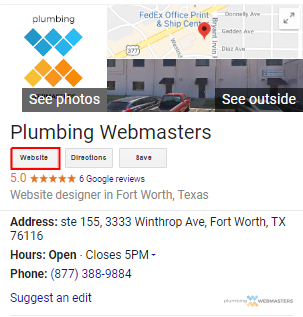
The button that says website, highlighted in red above, should link to the corresponding location page. So if you have a listing in Houston but are from Dallas, your Houston location should link to your Houston city page.
Most importantly, the address listed on your GMB profile should be identical to the one listed on the footer of your location page. You can even take it one step further and embed the Google Maps data onto the location page itself.
This way, Google crawls your webpage and knows precisely which Google My Business profile to associate with the page.
Some plumbers can’t afford an additional business location but still want to show up in more areas. Your best chance is to create subfolders for each city. It would be best to attempt this strategy only for cities you can drive to within an hour of your main office.
Each subfolder will serve as a mini-website of sorts and have 10-15 supporting pages to accompany it. For example, let’s say you’re targeting Corpus Christi. You will have a unique location page and additional pages for Sump Pump Repair in Corpus Christi, Slab Leak Repair in Corpus Christi, etc.
They must all be unique. For example:
Not only do you have to write multiple slab leak repair pages, but they should all have unique content. For example, you have to write the Corpus Christi slab leak repair page from the perspective of someone who resides in that area. That means no scraped content and gibberish.
Instead, referencing local landmarks makes the reader feel connected to the page they are consuming. It’s the only possible way to avoid doorway pages on your website and get your city pages indexed on search engines.
As SEO has progressed, software has been made available that solves many common problems for websites. As a result, the local SEO tool called DataPins solves the location page problem once and for all.
The tool allows plumbers to pin each job, including its location, through the mobile app. From there, DataPins publishes the pin, along with the attached pictures and caption, to the corresponding location page.
DataPins ensures each location page has unique content based on real-life plumbing jobs from your technicians.
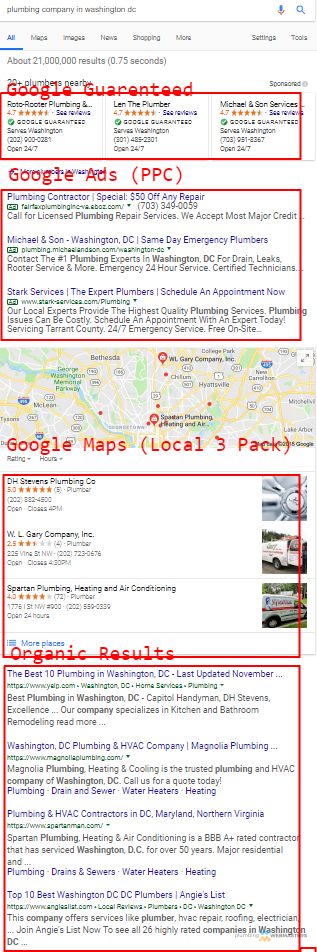
A SERP is an acronym that stands for Search Engine Results Page. It is the page a user sees after entering a search query into Google.
For the sake of demonstration, let’s perform a search for:
plumbing company in washington dc
You can break a SERP down into four primary sections.
There are also additional sections that appear on SERPs depending on the query. Some are:
Several features appear on a typical SERP, and each of them gives your plumbing company a chance to get more clicks, impressions, and visitors. Of course, some features have higher conversion rates than others, but plumbing companies who succeed online, usually optimize for all of the features available. Let’s take a look at some of the SERP features below.
Google Guaranteed is a green checkmark available to plumbers who buy Local Service Ads on SERPs. Local Service Ads are just a modern extension of Google Ads. To become Google Guaranteed, you will have to verify your plumbing company’s information and pass specific requirements by Google. You can learn more about how it works from Google.
The following visible SERP feature on a typical results page is Google Ads. Not every query will produce PPC ads on the SERP. For example, low-volume keywords may not show PPC ads because there’s not enough interest in the term, and therefore Google would be wasting money by advertising for that query. However, for mid to high-volume search terms, PPC ads will appear prominently, above both Maps results and traditional organic results. Securing your spot on the PPC section of a SERP requires an advertising investment. Google shows ads based on:
Maps listings appear beneath Google Ads but above traditional organic results. Like with PPC ads, they don’t show up for every single query. Most local plumbing terms create Google Maps listings, and it is critical to appear on what is known as the Local 3 Pack. This 3-Pack shows the top 3 local results and will drive much of your website traffic and direct calls from new plumbing customers. Here’s how you optimize for Maps listings:
Traditional organic results are the 1-10 listings that most people recognize. Websites earn rankings through search engine optimization, which provides the ideal user experience based on a specific search query. However, countless factors go onto Google’s final determination of a website’s organic ranking. Because of hundreds of factors, none of which are public, marketers are left to their own devices to develop best practice strategies. Here’s what Plumbing Webmasters knows about how to rank as high as possible on organic:
Google’s knowledge graph or knowledge panel is most common on branded search queries. Users who search for your company based on word-of-mouth, a business card, or some other outlet will see a different kind of SERP than would be presented from a more general query. Branded searches typically show knowledge panels, which are presentations of your Google My Business profile on the right-hand side of the SERP. Make sure your GMB profile is:
Another SERP feature to be aware of is the featured snippet. A featured snippet is a highlighted text block pulled from a relevant web page or article. Featured snippets primarily appear on SERPs for users who pose questions like, for example, how much does a plumber cost? Websites can earn more featured snippets by asking and answering questions within the content. Here’s what you’ll want to focus on:
Do you find the SERP features discussed in this blog foreign to you as a plumbing contractor? If so, there’s no shame in investing in a digital marketing firm to handle them on your behalf. Plumbing Webmasters optimizes clients for each of these SERP features with precision, putting plumbers in an ideal position to generate traffic from different sources throughout a results page.
Optimal SERP features are the result of a full-spectrum digital marketing effort. It’s not enough to create a website or write blog posts, or for that matter, pay for ad space. Google judges web presence on a macro level. At Plumbing Webmasters, we help contractors and companies become brands in the eyes of Google and generate exclusive plumbing leads in 2022.
Podcast: Play in new window | Download
Subscribe: RSS
Those who don’t learn from history are doomed to repeat it. This cliché applies to search engine optimization for plumbers as much as anything else. To understand how to execute SEO properly, you must understand its origin and its evolution.
1994: Yahoo launches
1996: Backrub launches (becomes Google in 1998)
1998: Paid search emerges along with goto.com
2005: Google Local Places/Maps launches
2011: Panda update
2012: Penguin update
2013: Hummingbird update
2014: Google Places becomes Google My Business
2015: Mobilegeddon + RankBrain
2016: Possum update
2018: Medic update
2019: BERT launches
2021: Page Experience update
While each update helped Google become the search engine powerhouse today, you can break the history of SEO down into two primary periods.
B.P., if you will, was a period before 2012 where SEO was the wild west in digital form. The best way to rank #1 during this period was to manipulate the search algorithm by sending as many inbound links as possible to your website. Anything from blog comments from offshore websites to barely readable computer-generated articles on irrelevant and spammy domains provided strong links for plumbers. The quality nor the relevance of the links mattered at all. The only things that mattered were as follows:
On April 24, 2012, everything in the SEO world changed. Google’s Penguin update dropped the hammer on spam links and severely penalized websites engaged in malicious link building. It was a big wake-up call for SEO’s, who’d become conditioned to violate guidelines in exchange for high rankings. And what worked in the past no longer did. After Penguin, blatant link schemes not only didn’t work, but they also hurt websites severely. As we once knew it, SEO had become nefarious, and everyone would have to learn to adapt. Here’s what Penguin changed:
Google makes regular algorithm changes to improve user experience for its consumers. While several SEO experts disagree with the frequency and intent behind many of the latest updates, an SEO’s job is to keep its clients in the best positions. At Plumbing Webmasters, we adapt to search engines requirements to keep our clients generating leads into 2022. Attempting to perform SEO as a one-time task ignores the essential principle of the discipline, which is adaptation.
Podcast: Play in new window | Download
Subscribe: RSS
The social media landscape in 2021 does not align with a plumber’s daily routine. So, while a bunch of college kids create false versions of themselves, frequently on beaches in the Caribbean, plumbers inspect the depths of a septic tank in Everytown, Illinois.
However, research confirms the importance of social media for plumbers, and according to speakers at SEO conferences throughout the U.S., social media signals have around a 20% influence over organic rankings.
The harsh reality is that ignoring social media because of personal disdain allows ego to get in the way of business. There are always aspects of a job that we’d prefer to ignore. Unfortunately, social media is now one of them for plumbers.
So how does an anti-social plumber leverage social media for the greater good? There are several ways and digital marketing agencies like Plumbing Webmasters can help. But the bottom line is this; you don’t have to be social to take advantage of social media.
People spend more time on Facebook than they do eating. The average person visits Facebook 14 times per day. As a result, Facebook is a great place to run a business ad. You don’t have to put up some contrived video while feigning enthusiasm. Instead, invest in a professional-looking ad with a high-quality photo and a call to action. You can even target demographics so that you narrowly focus on homeowners over 30 in your local service area (or anything that your target market calls for). In summary, advertising on social media provides these benefits:
If you hate the idea of social media entirely, you can hire a social media marketing firm to handle all of its aspects on your behalf. Plumbers who can afford to do so should also delegate these responsibilities to experts. Marketing involves republishing blog posts on Facebook, Twitter, and LinkedIn and sharing essential news updates on the same platforms. Instagram is the fastest growing social platform and requires visual content to require some form of concession on the part of the plumbing contractor. We can help make the process go smoothly. Here’s where you can market:
Yes, YouTube is social media, and yes, we know most of you don’t want to be on there. The good news is that you don’t have to be. Plumbing Webmasters does provide video packages that would serve as short commercials for your company. Furthermore, we offer YouTube ads as part of the Google Ads package (formerly AdWords). If you need help with any part of your social media campaign, don’t hesitate to give us a call. Just make sure you understand the importance of this medium to the overall strength of your online presence.
Podcast: Play in new window | Download
Subscribe: RSS



Hello! If you have any questions, leave your info below and we'll call you.